Unsuspend
Suspended cards in your battle area stand back up before you choose an action.
 DIGIMON ALYSION
A DIGIMON ALYSION turn is a memory race. You unsuspend, draw, use the breeding area, then spend the main phase until the memory counter reaches the opponent. The match itself is won through the security stack: check all 5 of the opponent's security cards, then attack them directly.
Suspended cards in your battle area stand back up before you choose an action.
Take one card from the deck. The player who goes first skips this on turn one.
Hatch a Digi-Egg, move a Digimon that already has DP, or pass. Pick only one.
A paid cost slides the memory counter toward the opponent and can end your turn.
Every suspended card you control in the battle area is unsuspended. DIGIMON ALYSION performs this step for you, so you do not ready each Digimon by hand.
At the start of your turn you draw one card. The opening player does not draw during that first turn. The app also handles this draw automatically.
You get a single breeding action. Hatch from the Digi-Egg deck, move a Digimon with DP from the breeding area into the battle area, or do nothing.
Order is yours. Digivolve a Digimon, play a Digimon card, play a Tamer, use an Option, and attack, as long as you can pay each cost.
When the memory counter shows 1 or more on the opponent's side, your turn stops and play passes across the table.
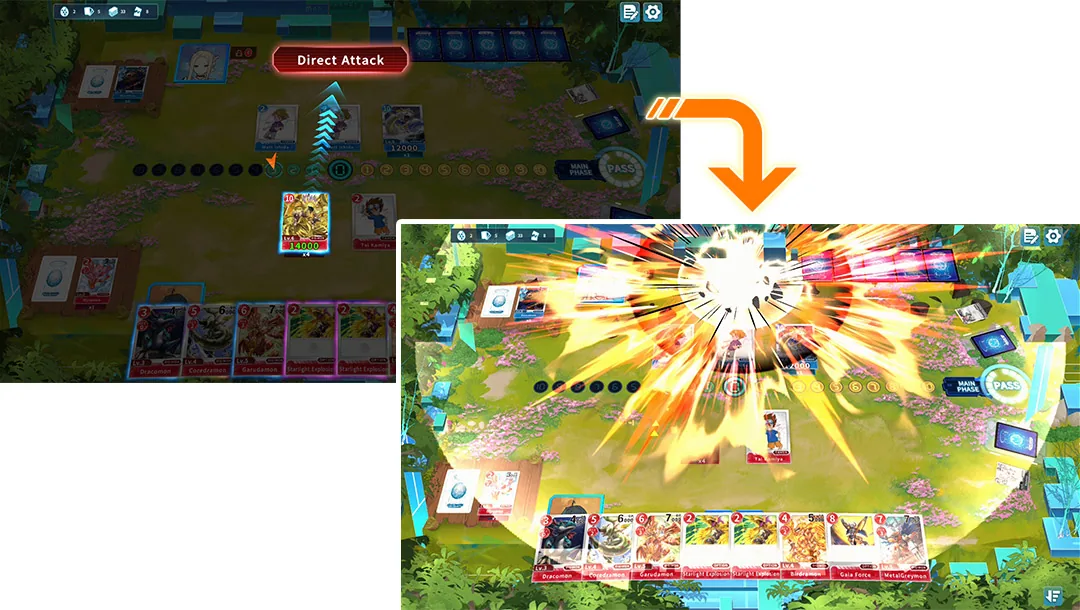
Victory is two steps. Check every card in the opponent's security stack — there are 5 — and then attack the opponent directly. Until that stack is gone, attacks are still running into security rather than ending the game.
Memory is the clock on each turn, not the win condition. Paying a cost, including a Digimon's play cost, moves the counter toward the opponent by the amount you paid. The moment it reads 1 or more on their side, the turn you are taking is over.
Stacking cards is how inherited effects come online. A digivolved Digimon carries the cards underneath it, and those buried cards can activate their inherited effects. That is the reason a breeding-area Digimon with DP is worth moving into battle, and why a cheaper digivolve changes how far you climb before memory flips.
| Zone | What it holds |
|---|---|
| Deck zone | Your 50-card deck |
| Trash | Where discarded cards go |
| Hand | Opens at 5 cards, with no cap |
| Battle area | Digimon and Tamers, with a placement limit |
| Breeding area | Hatched Digimon wait here |
| Digi-Egg deck | Up to 5 cards; hatch during breeding |
| Security stack | 5 cards, then a direct attack wins |
| Memory gauge | Costs push it; 1+ on the opponent ends the turn |
The main deck is exactly 50 cards. The Digi-Egg deck is a second pile of 5 cards or fewer. You may include up to 4 copies of the same card number, and the same Digimon can show up more than once when the card numbers differ.
You start holding 5 cards. There is no hand limit, so draws, Tamer effects, and Options can keep adding cards without forcing a discard for size.
Digimon and Tamers share the battle area, and that area has a placement limit. A new play waits once the area is full. The published turn list names the limit and leaves the number for the board itself.
Digimon cards attack and defend. DP is strength: in a battle, the higher DP wins. Play cost moves memory toward the opponent by that number. Digivolve cost is the price of stacking a card on top. An inherited effect can activate once that card is buried under a digivolution.
A Digi-Egg is hatched in the breeding area. Hatching is one of the breeding-phase choices, and the egg deck holds 5 cards or fewer.
Tamers are support cards you play into the battle area. Their effects include gaining memory and drawing cards.
An Option changes the course of the battle. You use it during the main phase, alongside plays, digivolves, and attacks.